Insights
/
feb 16, 2025
What we learned at AI DevCon India 2026
Agents aren’t the problem anymore. Operating them reliably at scale is — and that shift was clear across every conversation.
/
AUTHOR

Ans James
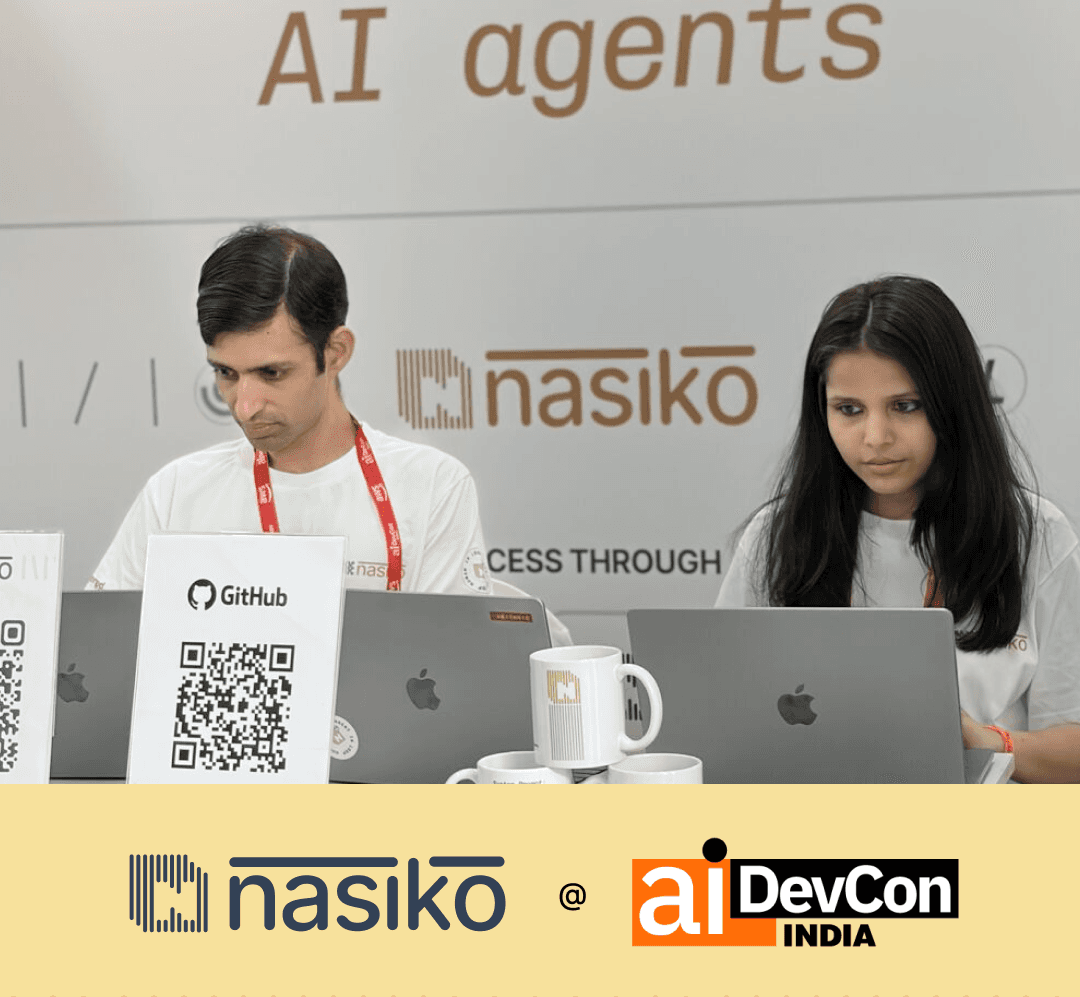
Nasiko participated as a sponsor at AI DevCon India 2026 in Bengaluru, engaging with 2,000+ developers, engineers, and technical leaders over two days. The event became a strong validation loop for how teams are thinking about agents — and where current approaches are breaking down.
We ran 100+ live demos of Nasiko, with consistent interest from developers looking to move beyond prototypes into production-ready systems. What stood out was not curiosity about agents themselves, but questions around reliability, orchestration, and control at scale.
The strongest signal came from the open-source community. We saw 200+ developers register to stay connected with the ecosystem, along with 45+ contributors expressing interest in actively building on Nasiko. Conversations here were deeper — focused on extensibility, deployment environments, and long-term ownership of agent systems.
Across discussions, a few patterns were clear. Teams are actively looking for better ways to integrate tools and workflows into agent systems, with requests around MCP-style tool calling, workflow orchestration, and credential management coming up repeatedly. There’s also a growing need for intelligent routing across agents, especially as systems become more complex.
Interestingly, one of the most common questions wasn’t technical — it was philosophical. Developers wanted to understand why Nasiko is open source, and how that decision plays out long term. This led to meaningful conversations around community, contribution, and building shared infrastructure for agent systems.
Overall, the takeaway is simple: agents are no longer the problem. Operating them reliably is. The demand is shifting from building individual agents to managing systems of agents — and that’s exactly where we’re focused.
AI DevCon wasn’t just a showcase moment for Nasiko — it was a clear signal that the need for structured, production-ready agent infrastructure is real and growing fast.