AI Strategy
/
feb 16, 2025
Inside our Bangalore build meetup with AI Collective
A small, high-signal room of builders. Less talk, more building — and sharper insights on how agents actually get deployed.
/
AUTHOR

Ans James
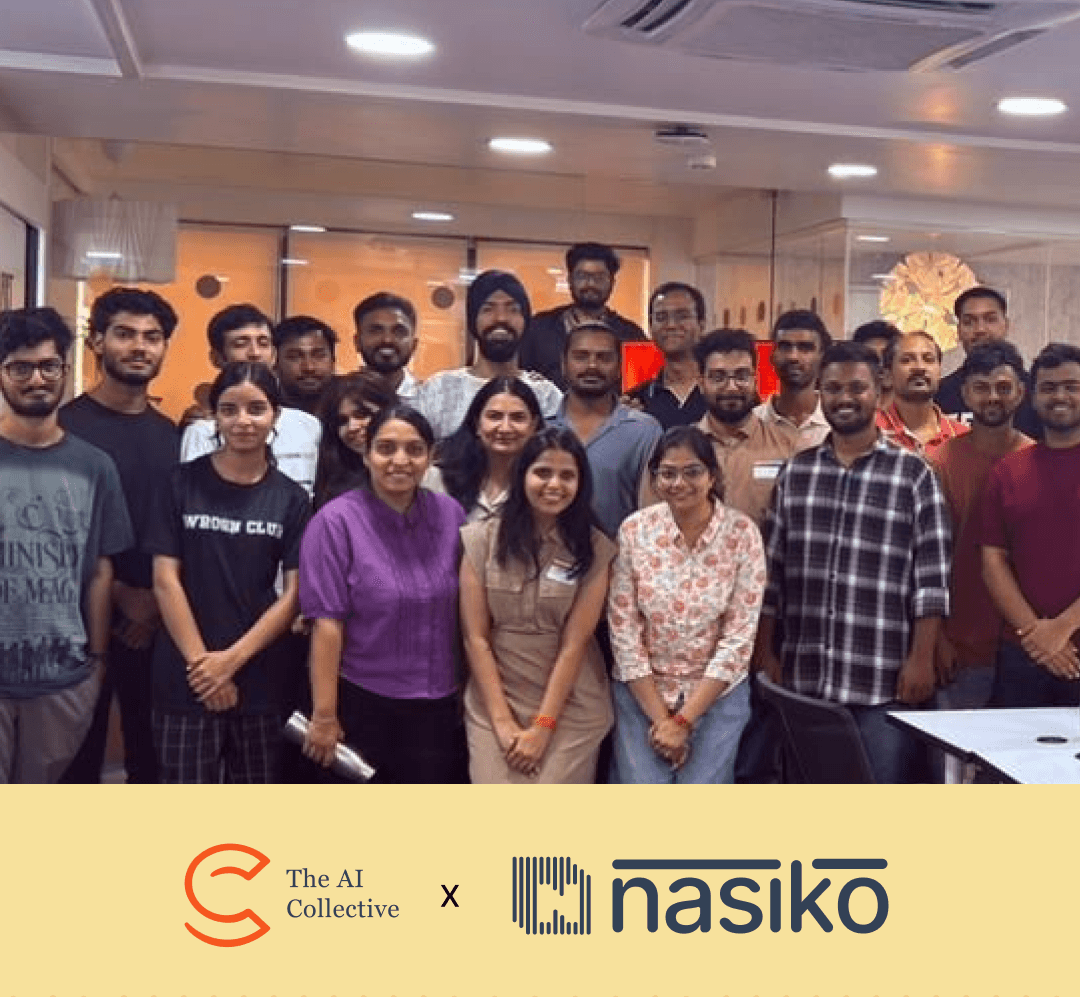
We partnered with AI Collective for a focused developer meetup in Bangalore designed around one idea: less talking, more building. Instead of a typical presentation-heavy format, the session brought together a curated group of developers and AI engineers to directly explore how agent systems behave in practice. Out of 192 registrations, 95 participants were approved, and 25 attended — but the smaller room turned out to be an advantage. The audience was highly intentional, technically strong, and willing to engage deeply, which quickly shifted the session from a demo into an active, ongoing discussion.
We began with a walkthrough of Nasiko, covering how agents are registered, routed, and observed as part of a larger system rather than isolated units. Almost immediately, the format broke into conversation. Developers asked questions in real time, digging into specifics like orchestration patterns, routing logic between agents, and how CLI workflows compare to interface-driven approaches. The focus was less on what the system can do, and more on how it behaves under real-world constraints.
The build session is where things became most valuable. As participants started deploying their own agents, friction points surfaced naturally — from infrastructure limitations under concurrent usage to expectations around pre-configured environments and better onboarding flows. What could have slowed the session instead became the strongest signal. Developers were not passively evaluating the product; they were actively testing its boundaries, asking detailed questions, and surfacing insights that directly map to how the system needs to evolve.
A few patterns became clear through these interactions. Developers are not looking for more abstraction layers; they are looking for systems that remain predictable and reliable when complexity increases. There is strong interest in hands-on environments over polished demos, in understanding system behavior rather than just outputs, and in having control over how agents interact, rather than relying on hidden orchestration. The depth of engagement in the room reinforced that when developers are given the space to build, they naturally expose the most meaningful gaps and opportunities.
The session also highlighted areas for improvement on our side. Infrastructure readiness for concurrent usage needs to be stronger, especially in shared environments. Providing sandboxed or pre-provisioned setups could significantly improve the onboarding experience during live sessions. Additionally, improving communication before the event could help increase attendance without compromising the quality of participants. These are not operational misses as much as signals on how to better support real usage scenarios.
Overall, the meetup validated something important: smaller, high-intent environments generate far stronger product signals than large-scale events. A room of engaged builders provides clarity that no amount of passive feedback can match. This wasn’t about scale or visibility — it was about depth, and that depth directly informs how we continue shaping the platform.