AI Strategy
/
feb 16, 2025
At MIT : The future of enterprise agents and agentic web Copy
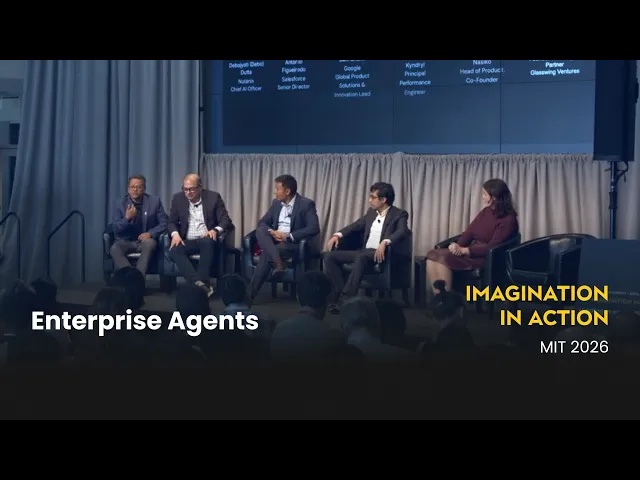
Nasiko joined leaders from across enterprise AI, cloud infrastructure, and research communities at the MIT Media Lab's Imagination in Action Summit to discuss one of the most important questions facing the industry:
/
AUTHOR

Ans James

Nasiko joined leaders from across enterprise AI, cloud infrastructure, and research communities at the MIT Media Lab's Imagination in Action Summit to discuss one of the most important questions facing the industry:
What happens when AI agents move from assistants to autonomous actors inside the enterprise?
Representing Nasiko, our co-founder Karan participated alongside leaders from Google, Salesforce, Nutanix, venture firms, researchers, and enterprise technology organizations exploring the next phase of AI adoption—the transition from isolated copilots to interconnected agent ecosystems.
The discussion focused on a shift that is becoming increasingly clear across the industry:
Enterprises are no longer asking whether AI agents will be deployed. They are asking how these systems can be governed, secured, observed, and trusted at scale.
Across the summit, a common theme emerged. While the industry has made tremendous progress in models and agent frameworks, the infrastructure required to operate large populations of agents remains largely undeveloped. Questions around identity, discovery, trust, reputation, permissions, governance, and interoperability are rapidly becoming enterprise priorities.
The conversation also highlighted the emergence of what many participants referred to as the "Agentic Web" or the "Internet of AI Agents"—an open ecosystem where agents discover one another, collaborate across organizational boundaries, and coordinate work on behalf of users and enterprises. Realizing this vision requires more than intelligent agents; it requires the infrastructure that allows those agents to operate safely and reliably.
One topic that generated significant discussion was enterprise trust.
As agents begin making decisions, invoking tools, accessing systems, and coordinating with other agents, organizations need answers to fundamental operational questions:
Which agent performed an action?
What permissions did it have?
Can its decisions be audited?
How is trust maintained across chains of delegated agents?
How do enterprises maintain governance across multiple frameworks and environments?
These challenges are increasingly becoming infrastructure challenges rather than model challenges.
This is the problem space Nasiko is focused on solving.
We believe enterprises need a dedicated control plane for AI agents—a system that provides identity, discovery, governance, observability, policy enforcement, and lifecycle management across agent ecosystems. As organizations move from dozens of agents to thousands, these capabilities become foundational requirements rather than optional features.
Events like MIT's Imagination in Action Summit reinforce what we're hearing from customers, researchers, and industry leaders alike:
The next phase of AI adoption will not be defined solely by more capable agents.
It will be defined by the infrastructure that makes those agents trustworthy, governable, and enterprise-ready.
We're excited to be part of that conversation and to help build the foundations for the emerging Internet of Agents.