Monitor
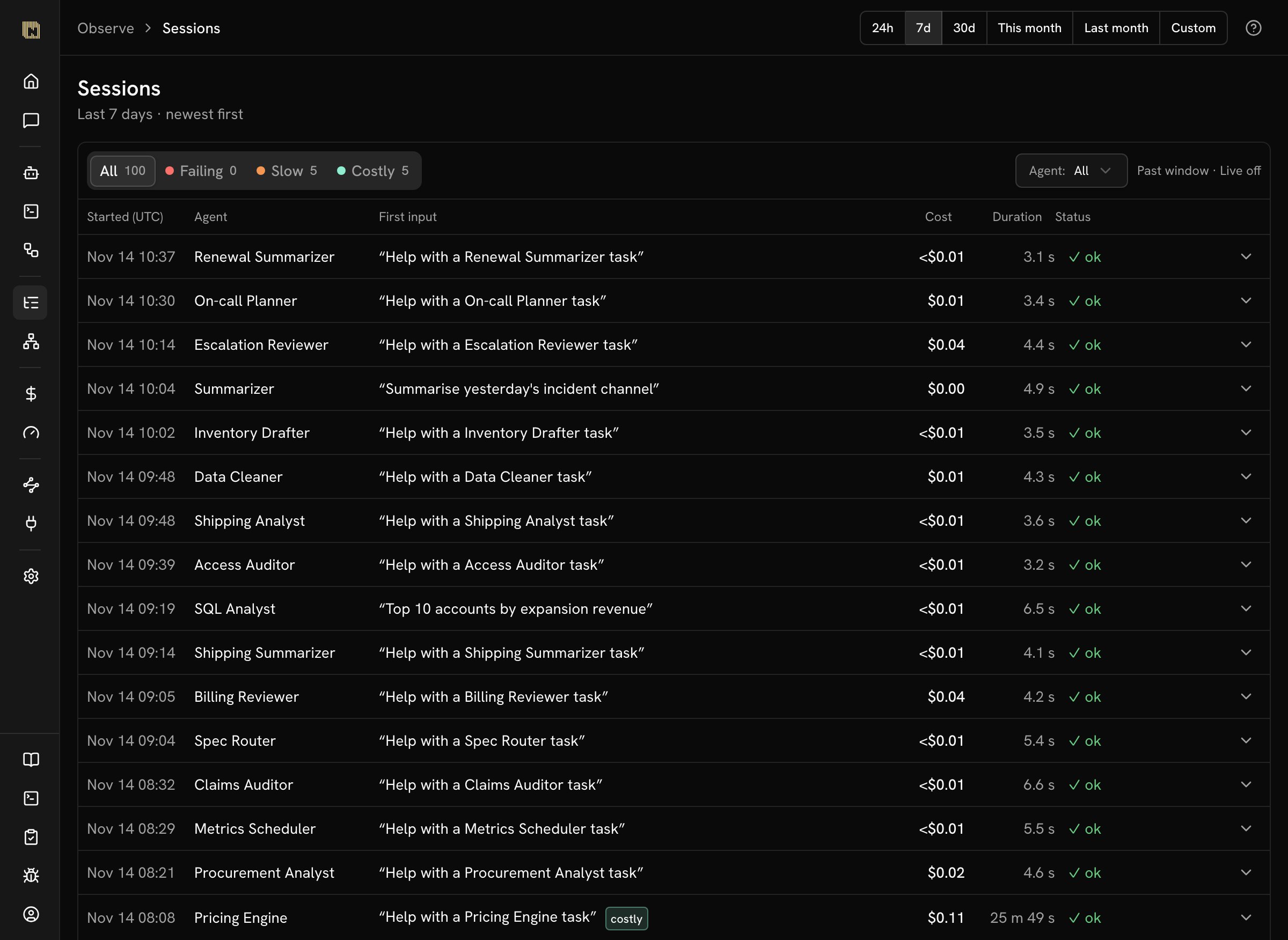
Every session, token and dollar, across every agent you run.
Agent spend compounds while you watch. TokenOps forecasts each run from its history, traces every call to its workflow, and stops the run at its budget, not at the invoice.
Every session, token and dollar, across every agent you run.
Fewer tokens on every turn, without changing how you work.
Which agents, models, keys and tools each team can use.
People write for people. Agents paste whole files and whole logs. The model reads every byte, and you pay for every byte.
Nasiko is the optimization layer.
It sits between your agents and the model, and sends only what the model needs: 42% fewer input tokens and 40% lower cost on real system logs.
Without Nasiko
With Nasiko · zero config
Observe › Sessions › Fix the flaky checkout test
Session · Coding agent · Oct 13 · $5.04 · ✕ failed
The coding agent ran the test suite 7 times; 6 runs failed on the same flaky test. 21 of 93 model calls re-sent files that were already in context, and every test run pasted its full log back in. The session timed out at 10:02, waiting on npm test.
One task, two terminals. The left goes straight to the model. The right goes through Nasiko.
History, code and logs are trimmed before the model sees them.
Without Nasiko
0
With Nasiko
0
−39% output, −18% cost, −39% time per typical task.
Fixing real bugs
Django bugs from SWE-bench Verified · mini-swe-agent · gpt-5.2
−44%input tokens
per typical task
Input tokens−44%
Output tokens−39%
Cost−18%
Time−39%
SWE-bench Verified, run twice: without and with Nasiko.
Time
0 s
✓ done · 20 steps
Agent steps 0 / 20
$ nl -ba django/utils/formats.py
└ 8,735 bytes, sent in full
Input tokens
Output tokens
Cost
Time
0 s
✓ done · 14 steps
Agent steps 0 / 14
$ nl -ba django/utils/formats.py
└ 8,735 → 5,330 bytes · body elided, line numbers kept
Input tokens
Output tokens
Cost
Typical task (median of 10 SWE-bench Verified Django bugs) · mini-swe-agent · gpt-5.2 · replayed 120× faster
−40% cost per correct answer on real system logs.
Finding errors in logs
50 questions over real system logs · gpt-4o
−42%input tokens
per typical question
Input tokens−42%
Cost per correct answer−40%
Correct answers (of 50)No change
Savings by log type
Biggest where errors are rare: routine lines are what gets shortened.
Real file views from the coding test.
A real HDFS read from the log test, answer kept.
Each provider dashboard shows one vendor, totalled by API key. TokenOps attributes every call to a run, workflow, team and customer across all your providers, so a tenfold jump in one workflow doesn’t vanish into the monthly total.
A cap stops all work once a number is hit. TokenOps sets budgets per workload: new workloads are watched but never stopped, production workloads get a default limit, and usage you bill onward is capped per customer. A run that hits its cap is stopped and logged with what it had already produced.
Yes. TokenOps uses past traces of the same workflow to estimate tokens and cost as a range, then shows live spend against that estimate. A run drifting to ten times its estimate shows up within seconds.
Yes. The homepage shows the same Claude Code task run with and without Nasiko optimization, token by token.