Blogs
How we think about agent infrastructure
Essays from the Nasiko team on TokenOps, context engineering, multi-agent systems, and the infrastructure underneath the agentic web. Latest first.

Nasiko is now available on the DigitalOcean Marketplace
Nasiko is now a one-click offering on the DigitalOcean Marketplace: the fully managed open runtime, from the registry up, with TokenOps for what the work costs, policy and security for what it may do, and Meta-Harness for what it is.

Nobody Can Prove Who Authorised the Agent. We Checked All Thirteen Protocols.
We scored thirteen inter-agent protocols on one ten-axis rubric, with a recorded reason for every cell. Not one specifies a delegation chain a third party can check, and the strongest specifications are the least deployed.
We Scoped Down Our Agent Skill Library. You Might Not Need One at All.
“A library of skills the agents learn” is a seductive phrase, and it does not survive contact with how agents are actually deployed. Part 3 of the memory architecture series: why the procedural tier is authored, not observed — and when to skip it entirely.
How We Built Security Into Nasiko Before We Needed It
The security document you most want during an incident is the one you wrote before it. What changed once we started treating security as something you prepare, not something you improvise.
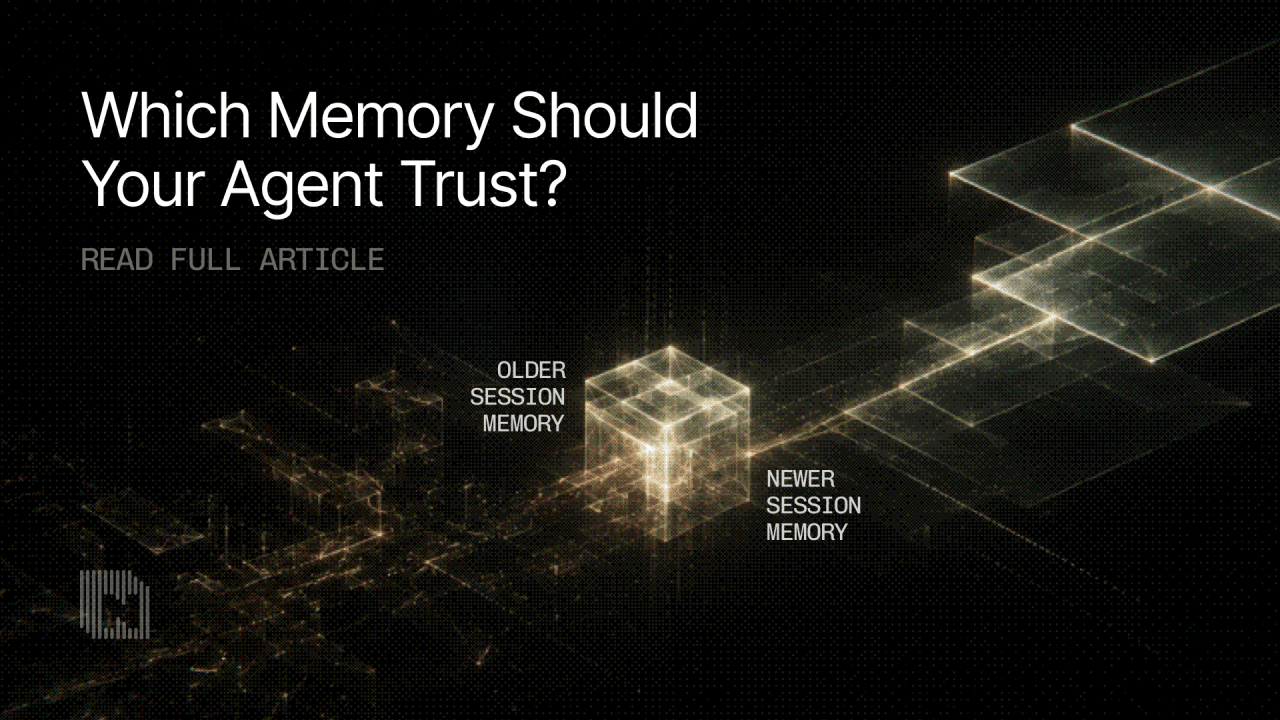
One Belief Per Fact: Building Agent Memory for Users Who Change Their Minds
A user says she is cautious with money. Next session, she wants individual tech stocks. Part 2 of the memory architecture series: one belief per fact, current, with the versioned history to prove it.
How We Strengthened Agent and MCP Security in Nasiko
An MCP tool can act with whatever privileges its server has, and any string an agent reads can carry an instruction. Notes from three weeks in the GitHub Secure Open Source Fund, and why we started treating our own agent surface as untrusted input.
How We Hardened Nasiko's Software Supply Chain
The follow-up we promised on the GitHub Secure Open Source Fund: pin the pipeline, scope the token, vendor what you ship, and treat maintainer accounts as part of the supply chain.
Agents Shouldn't Pass Context. They Should Share Memory.
Every additional agent in a chain is supposed to make the system smarter. Too often, it just makes the prompt bigger. Part 1 of the memory architecture series: pass by reference, not by value.
Your Agents’ Most Expensive Habit Is Carrying Every Tool to Every Job
Every MCP server you expose can pay rent in the model's window on every call, whether the tool gets used or not. MCP made tools easy to connect; TokenOps makes them deliberate to expose.
The Best Prompt in the World Can't Answer From Information That Got Truncated
Prompt engineering tells the model what to do. Context engineering determines whether the model has what it needs to do it. In production agents, that second problem covers most of the token surface and most of the failure surface.
Bigger Windows Raise the Ceiling. TokenOps Decides What's Context-Worthy.
The next frontier for AI agents isn't holding more tokens. It's deciding which tokens earn a place in the prompt. Bigger windows raise the ceiling; TokenOps is the discipline that decides what's context-worthy.
The hidden cost of unmonitored agents
Agents do not fail loudly. Silent failures, runaway costs, and shadow agents: what happens when production agents operate without observability, and why the damage is hundreds of small failures, not one big one.
Intelligent Routing: How Nasiko Picks the Right Agent
The moment a system evolves from one agent to many, a new question emerges: who should handle the task? Inside the coordination layer, where routing decisions, context sharing, and agent handoffs decide whether the work actually gets done.
Registries Turn Agents From Experiments Into Infrastructure
Every major shift in software eventually produces an operational layer, and it always arrives after the technology itself. For AI agents, that layer starts with a registry: identity, discovery, and trust.
Who's in Charge? The Control Problem in Multi-Agent Systems
The system produced the right output. The question that stayed with us was “who approved that?” A look at accountability, auditability, and control in systems that are increasingly capable and increasingly hard to explain.
The Missing Piece in Multi-Agent Systems
Building AI agents has gotten easier. Running them reliably in production has not, and the gap between those two sentences is an operational layer that doesn't exist yet.
Introducing Nasiko: The Control Plane for AI Agents
AI is moving beyond chatbots, toward agents that reason, use tools, and execute workflows autonomously. Nasiko sits underneath the ecosystem as the missing operational layer: how agents are registered, discovered, routed, secured, deployed, and monitored.
Publications
Research from the team
Papers we've published on the infrastructure underneath agentic systems: the ideas the platform is built on, in the open. Latest first.