Blogs
The hidden cost of unmonitored agents
Nasiko
Silent failures, runaway costs, and shadow agents, what happens when production agents operate without observability.
Every team building AI agents asks the same question at the start: does it work?
The question nobody asks until it is too late: do we know what it is doing?
Those are not the same question. And the gap between them is where trust disappears, quality erodes, and problems stack up for weeks before anyone connects the dots.
Building an agent is becoming commoditized. Operating them reliably, efficiently, and safely is not. The organizations that win won't necessarily have the most agents. They will have the ones they can actually understand.
Agents do not fail loudly
Normal software crashes. An error appears, a service goes down, someone gets paged. The failure is obvious and the fix starts immediately.
Agents fail differently.
They keep running. They keep producing output. But something underneath has shifted. A prompt changed, a model got swapped, a task started looping. The results get slightly worse, or costs quietly climb, and nothing in your existing monitoring tells you it is happening.
This is what a silent failure looks like. And it is the default failure mode for unmonitored agents.
The shadow agent problem
It usually starts with one team. They build a small internal assistant. It works, so another team does the same. Then engineering connects agents to deployment. Support routes tickets through AI. Finance builds a reporting agent.
Nobody planned for this. It just accumulated.
Within a year, most companies have dozens of agents running across departments with no central record of what each one does, what data it touches, or what it costs.
You cannot control what you cannot see. And right now, most organizations cannot fully see their own agent infrastructure.
What the numbers actually look like
This is not a theoretical risk. We ran the numbers on a mid-sized deployment:
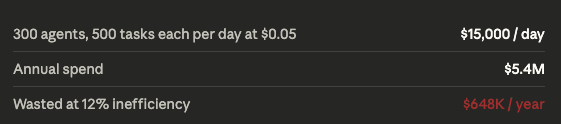
That 12% is not a dramatic failure. It is agents looping, prompts that are longer than they need to be, calls going to expensive models when a cheaper one would do the same job.
Small leaks that compound because nobody is watching.
At this scale, observability is not an engineering concern. It is a budget line.
What companies are doing about it and why it is not enough
Most teams are not ignoring this. They are patching it with whatever is available.
Some use OpenTelemetry to capture traces across their agent runs. It gives them raw data. What it does not give them is meaning. The traces exist, but making sense of them at agent level still requires significant custom work on top.
Some use Langtrace or similar tools built for LLM observability. These are a step closer. They track prompts, model calls, and token usage. But they were designed for single model calls, not for the full execution of an agent that coordinates tools, retrieves knowledge, and triggers other agents.
Some build their own dashboards. Custom logging, cost alerts, spreadsheets tracking who owns which agent. It works until the team grows or the agent count doubles.
Every one of these approaches answers one question. Running agents in production asks dozens at once.
The question observability actually needs to answer
Standard monitoring asks: did the API return 200? Is the CPU above 80%?
Agent observability asks something different.
Which prompt produced this result? Which agent triggered three more downstream agents? Why did this task cost six times more than yesterday? Which team owns the agent responsible for 40% of this month's bill?
When did behavior change, and what caused it?
These are not infrastructure questions. They are execution questions. And answering them requires a layer built specifically for how agents work, not adapted from tools built for something else.
What Nasiko is built to do
Nasiko is that layer.
Not a logging tool with an AI label on it. Not OpenTelemetry plus a dashboard. Built from scratch around the specific reality of teams running agents at scale, across different frameworks, different models, different providers, all at once.
What it gives you:
Full execution traces in plain language. Not raw logs. What happened, why it happened, and where it went wrong. Cost visibility by agent, team, and task. Know where money is going before the bill arrives, not after. Silent failure detection. When an agent starts behaving differently from its baseline, Nasiko surfaces it early. A single view across your entire agent infrastructure, regardless of how many tools, models, or providers are underneath. Setup in an afternoon. No months of custom work. No thresholds to configure from scratch.
A real example
A support team running 30 agents saw response quality drop over two weeks. Existing tools showed nothing wrong. Normal latency, no errors, no alerts.
With Nasiko, they found the cause in ten minutes.
A prompt update three weeks earlier had changed how agents classified ticket urgency, causing them to skip a step that pulled in customer account context. Every response since was technically correct but missing what customers actually needed.
No crash. No alert. Just a quiet change that nobody connected to the outcome until they could see the full picture of each execution.
The bottom line
"You cannot fix what you cannot see. You cannot trust what you cannot trace."
Other tools tell you your agents are running.
Nasiko tells you what they are doing, whether it is working, what it is costing you and what it does, without months of setup or a team of engineers maintaining custom infrastructure.
The hidden cost of unmonitored agents is not one big failure. It is hundreds of small ones, stacking up quietly, every day. The only way to stop it is to be able to see it.
Running agents in production and feeling the gaps described here? We would like to hear what you are running into.