Finding an agent is only the beginning. Nasiko & NandaIndex

Imagine an online electronics retailer running low on a popular pair of headphones. Its purchasing agent needs to reorder from an approved distributor. How does it find the distributor’s ordering agent? And what evidence confirms that the agent actually represents that distributor?
Before allowing the order, the retailer needs both answers. It also needs limits on the quantity and price its agent can approve, along with a record of the transaction. Getting two agents to communicate is only part of making that purchase work.
NandaIndex v1 addresses the discovery problem: finding agents across the directories where they are listed. At Nasiko, we build runtime software that applies policies to agents and records their activity. We are helping build NandaIndex to work on how that discovery process connects to the controls teams need before they let agents transact.
Connecting the directories agents already use
The retailer may know which distributor it wants to buy from without knowing which directory lists its ordering agent. Agents can appear in company catalogs, platform registries, gateways, and other directories, each with its own way of finding records.
The NandaIndex draft calls these “discovery islands.” A directory can work well for its own users while remaining difficult for everyone else to navigate. Asking the distributor to register separately in every system its customers use would make that fragmentation the distributor’s problem.
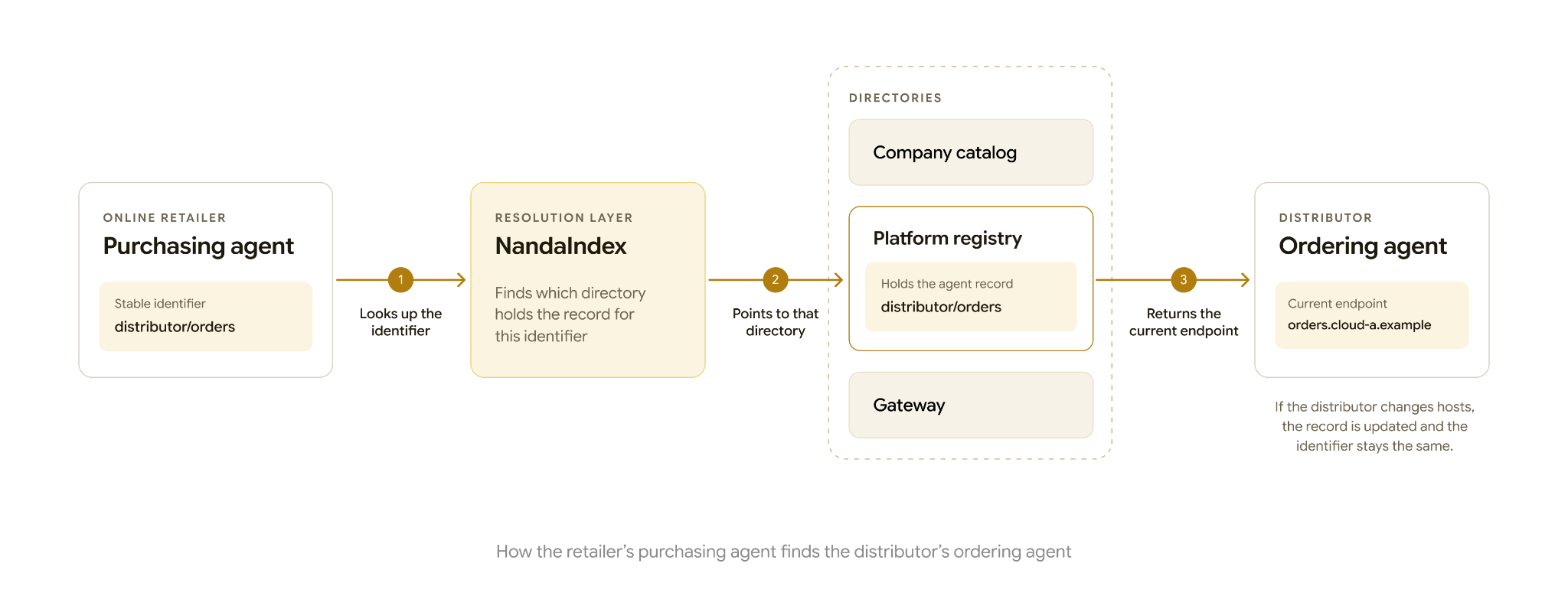
NandaIndex proposes a resolution layer across those systems. Given a stable identifier for the distributor’s ordering agent, a client can locate the directory holding its record and continue discovery there. The directory keeps responsibility for that record.
This also separates the identifier customers use from the location where the agent runs. If the distributor changes cloud providers, it can update the underlying record while its customers keep using the same identifier.
Before the retailer places an order
Suppose the retailer has used that identifier to find a record and an endpoint. It now has somewhere to send a request. But a record claiming to represent the distributor could be outdated, incorrect, or fraudulent. The retailer still needs evidence connecting the agent to the business it intends to buy from.
Even with that evidence, the transaction needs controls. The retailer’s purchasing agent must stay within approved quantities and prices, and the retailer needs a record of what it ordered and approved. Verifying the distributor’s identity would not give the retailer’s agent permission to spend without limits.
The NandaIndex draft distinguishes discovery from authentication and authorization. That distinction tells builders what they still need to provide after they find an agent. Identity systems must prove who operates them. A runtime must apply the rules governing the call and record what happens.
A VP at PayPal explained it this way. “In just the last few months, we have seen AI agents acting on behalf of consumers and businesses dramatically rise. For an open agentic economy to scale, agents must be able to discover relevant services across fragmented ecosystems. An open discovery effort like NandaIndex is an important step in that direction, and we welcome the industry conversation on how verified identity, trust, and secure commerce can be built on top of them.”
Nasiko’s part
Nasiko is the Open Runtime for AI agents: a vendor-neutral runtime for registering, deploying, routing, securing, and observing agents.
For a team like the retailer’s, the runtime is where its rules have to take effect as agents interact with other systems. The team needs to control access, account for agent runtime costs, and investigate failed calls or unexpected results.
In Nasiko, the gateway provides a point to apply access policy, track token spend, and record calls across supported agents, MCP servers, and tools.
For those controls to work across organizations, the runtime needs reliable information about the agents involved. Finding the distributor’s endpoint cannot silently prove it belongs to the distributor. Policy-enforcing software needs to know what evidence supports that claim.
Why Nasiko is helping build it
We want to work through that handoff alongside the teams building discovery infrastructure. Nasiko and Project NANDA share roots in the MIT Media Lab research community. Our co-founder Ramesh Raskar leads Project NANDA, and our Head of Product and co-founder Karan Bharadwaj is a co-author of the NandaIndex paper.
Our engineers have contributed to NandaIndex and NandaTown alongside the NANDA community. As we contribute, we want to test how discovery and runtime software fit together. The v1 draft raises questions about binding email-based identities to agent records, establishing trust between indexes, and defining the handoff between resolution, discovery, and runtime.
For Nasiko, the handoff matters most. What identity evidence should accompany a resolved record, and how can a runtime verify it? What should happen when that evidence expires, or two systems disagree? An implementation needs explicit answers. Otherwise, each team connecting a directory to a runtime has to make its own assumptions about what the other system has checked.
Why we are doing this in the open
Other teams will have to live with the choices made in these specifications. The distributor should be able to choose its hosting provider without losing the identifier its customers use. The retailer should be able to choose a runtime that meets its purchasing requirements and still find suppliers using other systems.
Open specifications let those builders inspect the design and challenge its assumptions. Open implementations let them test whether it works with their own software. Publishing the draft now gives them a chance to influence how discovery, identity, and runtime systems connect.
If you build agents, read the NandaIndex v1 draft and try its registration flow. You can also try Nasiko on GitHub. We would particularly welcome feedback from people connecting discovery to identity checks and runtime policies, including examples where the proposed design leaves a decision unclear.
We are grateful to the NANDA community and the collaborators building and reviewing this work.